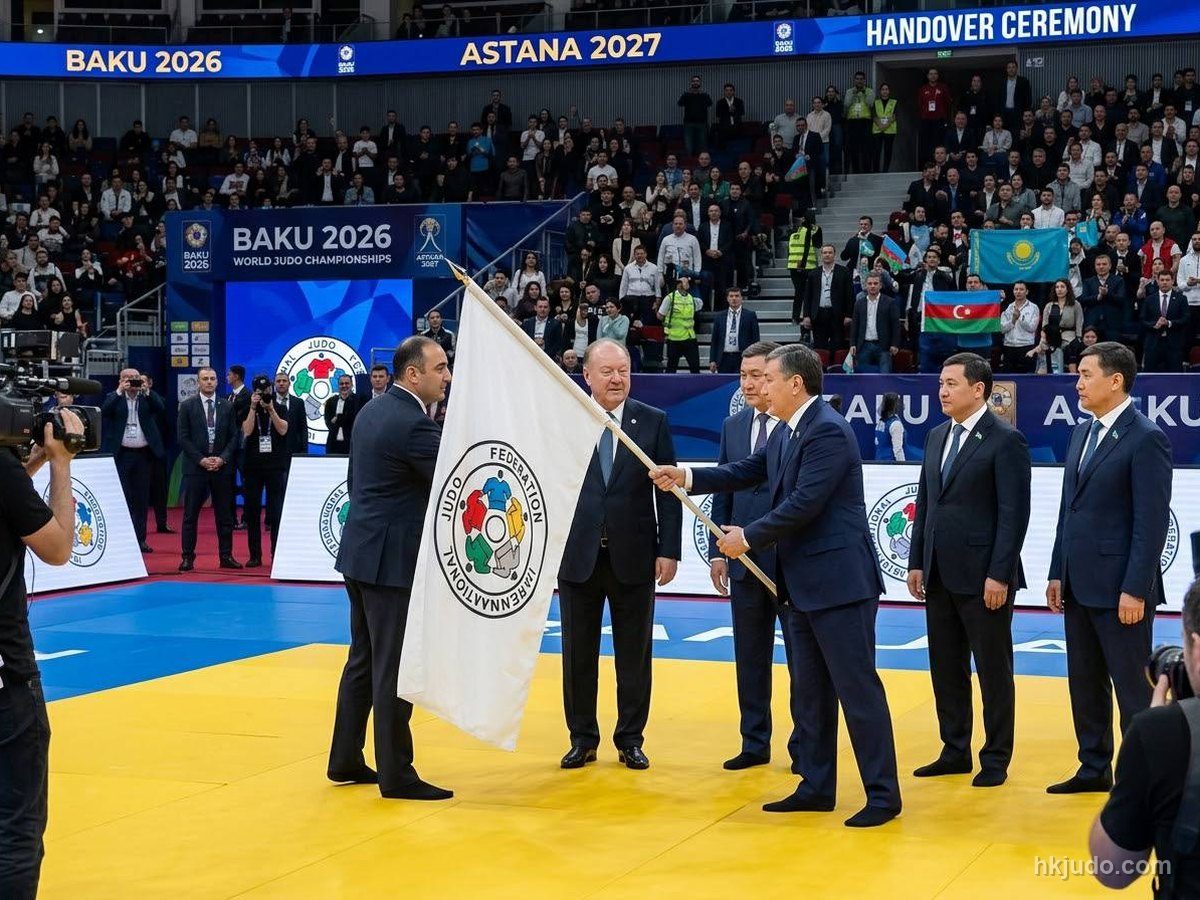
Habib Sissoko received his 8th Dan diploma from International Judo Federation (IJF) President Marius Vizer during the 2026 World Judo Championships in Baku, in recognition of his long-standing contribution to judo leadership, development and the transmission of knowledge.
Sissoko is a veteran of Malian judo. He is a former president of the Malian Judo and Jujitsu Federation and of the African Judo Union, and currently presides over Mali's National Olympic and Sports Committee.
The grading record behind the award is a compact one. Sissoko received IJF 7th Dan in 2023, the year the African Judo Championships were held in Casablanca, Morocco, while the IJF's published list of 8th Dan grades records his 8th Dan with the year 2025. The diploma itself was presented publicly in Baku in 2026.
That progression also illustrates one aspect of the modern international grading system: beyond technical and competitive achievement, long-term work in administration, leadership, education and international development can form an important part of senior-rank recognition.
The Kodokan high-dan path: time is only the beginning
At the Kodokan in Tokyo, the birthplace of judo, senior promotion follows a different and highly demanding traditional framework that has been preserved to the present day.
Kodokan high-dan promotion is not based on time served alone. Using the commonly referenced “Good” (ryo) assessment as an example, the minimum periods are nine years from 5th to 6th Dan, twelve years from 6th to 7th Dan, and fifteen years from 7th to 8th Dan. Those periods are only one part of eligibility for consideration.
Promotion from 5th to 6th Dan still requires designated shiai points. At 6th Dan and above, assessment broadens to take in present and previous competitive records, kata, refereeing, teaching record, continuing practice, and contribution to the spread and development of judo.
Crucially, a high dan rank does not mean leaving competition behind. Kodokan high-dan tournaments still place judoka of 5th Dan and above on the tatami, and for those seeking further promotion, actual high-dan shiai records can form part of the formal assessment.
In other words, even as a 6th or 7th Dan — and even at an advanced age — a judoka is still expected to keep training, study kata, teach, and, where required, return to the tatami. The difficulty of Kodokan high-dan promotion is therefore not simply a matter of waiting long enough; it is about remaining capable and worthy of continued practice ten or twenty years later.
In the Kodokan tradition, a high dan rank is not the end of practice. It is evidence that the judoka has never left judo behind. After all, in the end, only the rank you have fought for yourself truly has meaning.
Sources
- International Judo Federation|Habib Sissoko Awarded 8th Dan in Recognition of a Lifetime in Judo
- International Judo Federation|List of IJF 8 Dan awardees (updated 12 August 2026)
- International Judo Federation|African Senior Championships Individuals 2023, Casablanca
- Kodokan Judo Institute|昇段資格について (promotion qualifications)