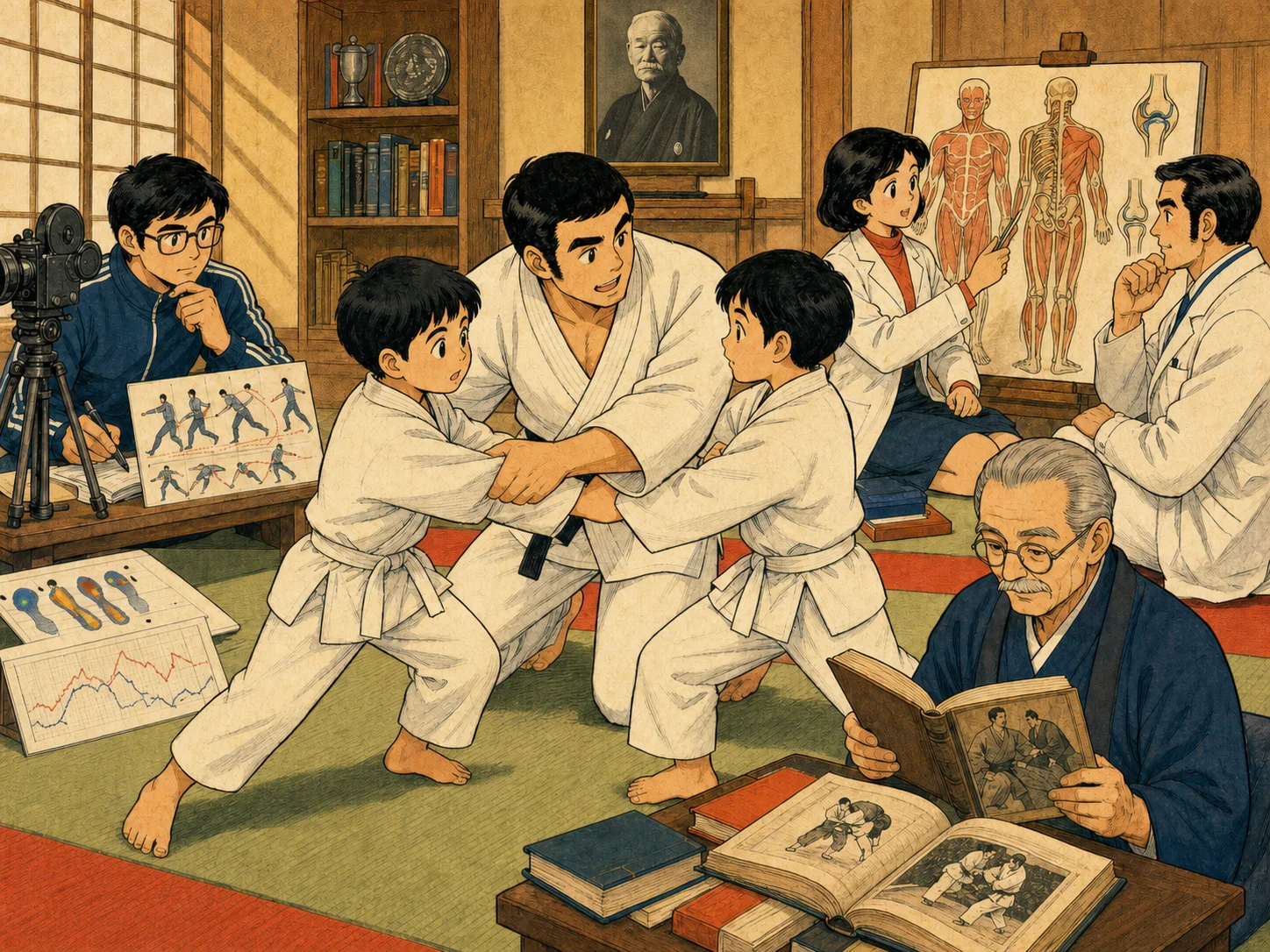
1970s Japanese educational manga-style illustration of a judo coach and children training while sport science, medicine and history researchers observe, with an accurate portrait of Jigoro Kano on the wall

The Arts and Sciences of Judo

IJF Education / Judo Research

The Arts and Sciences of Judo, Volume 6, Number 1 is not one report with one conclusion. It is an issue of the IJF's interdisciplinary journal containing several different studies. This page explains in plain English what was examined, what the authors found and where the evidence still needs careful interpretation.

About the journal

Not one experiment, but a platform for judo knowledge

Published by the IJF Academy, The Arts and Sciences of Judo is an open-access interdisciplinary journal. Its scope reaches beyond sport science into medicine, psychology, education, history, philosophy, biomechanics, management and communication. Volume 6, Number 1 contains 11 academic papers and one commentary, using different methods such as questionnaires, a small pilot study, historical review, conceptual analysis, comparative observation and descriptive data analysis.

The most important reading ruleWhen a paper explores a possibility, that is not the same as proving an effect for everyone. This guide identifies the study type and its limitations, especially where children, health or ADHD are discussed.
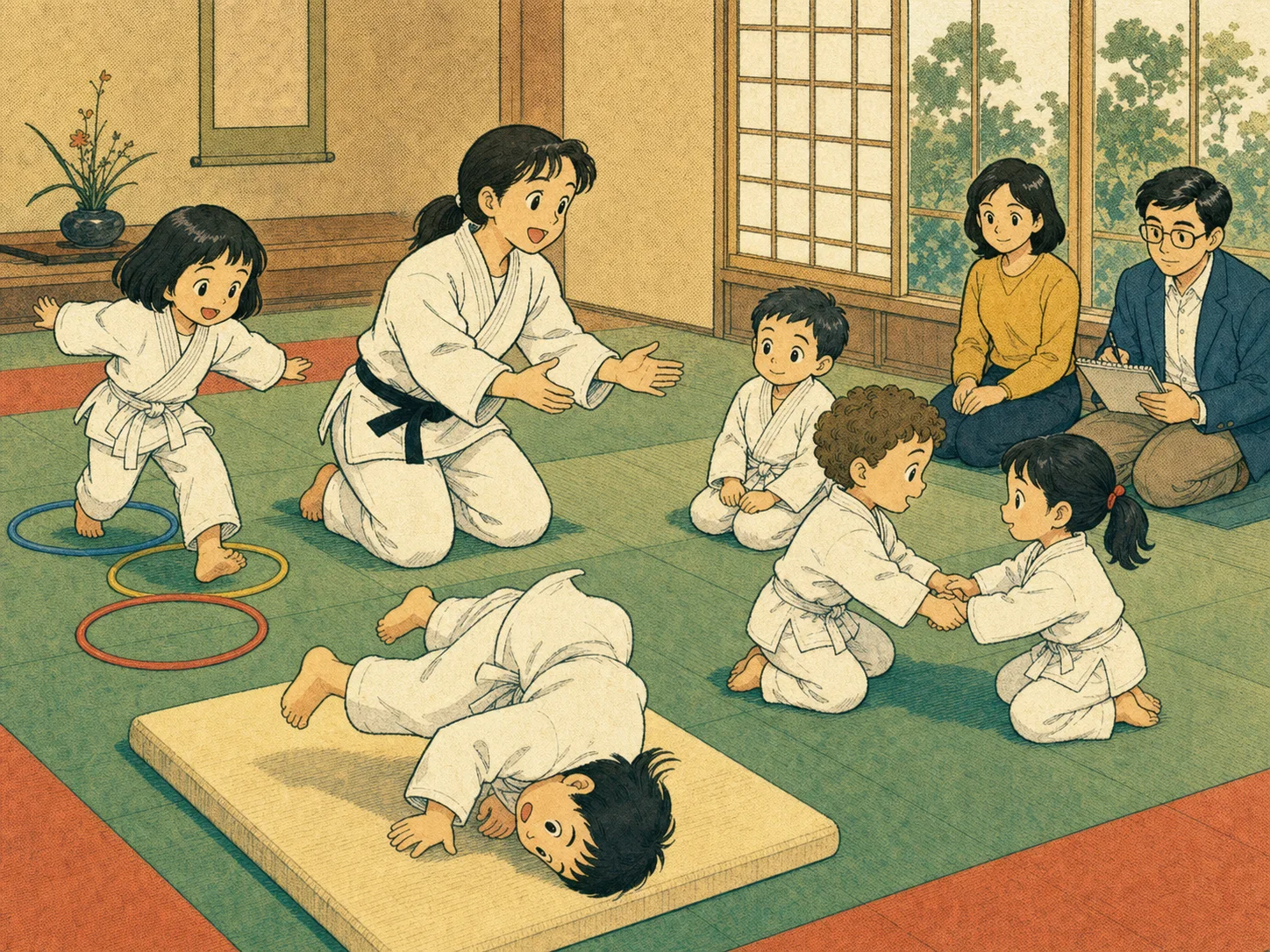
1970s Japanese educational manga-style illustration of a coach teaching young children safe balance, rolling and cooperative judo movement games
Preschool judo is presented as learning through movement, rules, cooperation and feedback, not as a smaller version of adult competition.

Education and child development

Judo can be an educational method, but how it is taught matters

Ages three to five: carrying skills from the dojo into daily life

The EducaJudo study describes an Italian preschool programme implemented in 2024 and includes a survey of 481 parents. Parents reported positive changes in autonomy, respect for rules, emotion management, attention and confidence. These findings come mainly from interviews and parent reports; they are not equivalent to a large randomised controlled trial.

Preschool judo is more than preparation for future competition

Another paper uses Jigoro Kano's educational philosophy to propose preschool judo as a distinct stage for children aged four to six. Its aim is to develop self-regulation, respect, cooperation and social interaction through movement. This is a theoretical model that still requires further empirical testing.

ADHD: educational support, not treatment

One conceptual paper discusses judo and ADHD education through dopamine and noradrenaline mechanisms. It argues that regular lesson structure, immediate feedback, skill progression, partner interaction and physical activity may help children with ADHD practise attention, self-regulation and behavioural control in a dynamic setting. This is not a clinical trial and does not prove that judo treats ADHD. Judo should be understood as an educational and developmental support, not a replacement for professional assessment, school support or medical care.

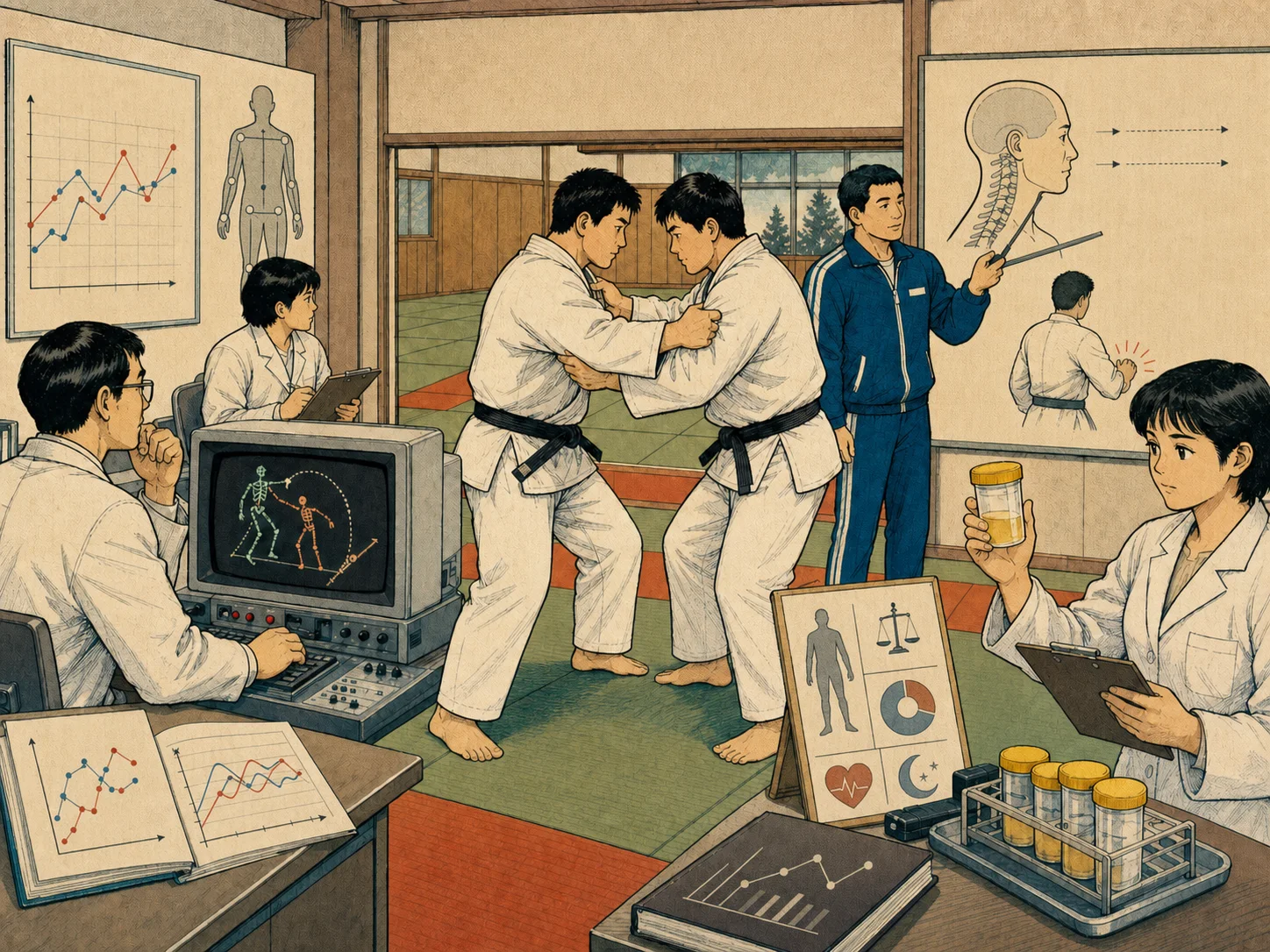
1970s Japanese educational manga-style illustration of researchers observing judo movement, recovery measures and supervised safety responses
Observation and measurement can turn familiar dojo experience into testable questions about movement, recovery and safety.

Sport science and safety

Science does not replace the coach; it helps the dojo ask clearer questions

Shime-waza: experience, awareness and communication

Japan has prohibited shime-waza in junior-high-school competition since 2022. One study surveyed 340 junior-high-school judoka about shime-waza, transient loss of consciousness, reporting and psychological impact. Its practical value lies in highlighting supervision, communication, reporting and appropriate return-to-practice decisions. It is not an invitation for children to try choke techniques; local rules, age restrictions and qualified supervision come first.

Bilirubin: an interesting pilot with only nine athletes

A small pilot compared bilirubin and other stress markers before and after judo training and competition. Urine appeared promising for future non-invasive monitoring, but nine participants are not enough to create settled training or nutrition guidance.

Decision-making in under two seconds

Another paper proposes an 18-scenario circuit framework built from fighting side, relative height, posture, grip and movement direction. It is a systematic design for coaches to test, not yet proof that the framework improves performance.

1970s Japanese educational manga-style illustration of older adults in Hong Kong learning balance and safer landing positions on thick mats beside a handrail, under qualified supervision
Older adults can practise balance and safer landing positions progressively, using thick mats, a handrail and qualified supervision.

Older-adult fall safety and ukemi

Fall prevention begins with balance and strength

The first aim of fall prevention is not to teach people how to fall, but to help them remain steady. Regular work on leg and core strength, balance, mobility and coordination can make standing, turning and using stairs safer, while improving the body's ability to recover after a trip. Hong Kong's Department of Health likewise identifies strength and multicomponent balance training as important parts of fall prevention.

Where can judo contribute?

Ukemi adds a second layer of protection. Once balance has been lost, breakfall practice teaches people to protect the head and neck, avoid bracing with a straight arm and spread impact across a larger area. The Safe Falling Programme discussed in this journal adapts these ideas into progressive practice for older adults, with the aim of reducing injury when a fall occurs.

How should practice begin?

Older adults should not begin by taking full standing falls. A safer approach starts on thick mats, beside a handrail and with qualified support, learning from a seated or low position before gradually adding standing balance, stepping reactions and strength work. The journal contribution offers a practical direction for programme design; further research is still needed to measure its long-term effect on real-world falls and injuries.

Anyone with osteoporosis, balance disorders, joint problems or other health concerns should consult a doctor or physiotherapist before beginning a new programme.

In shortBalance and strength training can reduce the risk of falling. Ukemi can help a person land more safely when balance is lost. Together, they offer a more complete approach to older-adult fall safety.
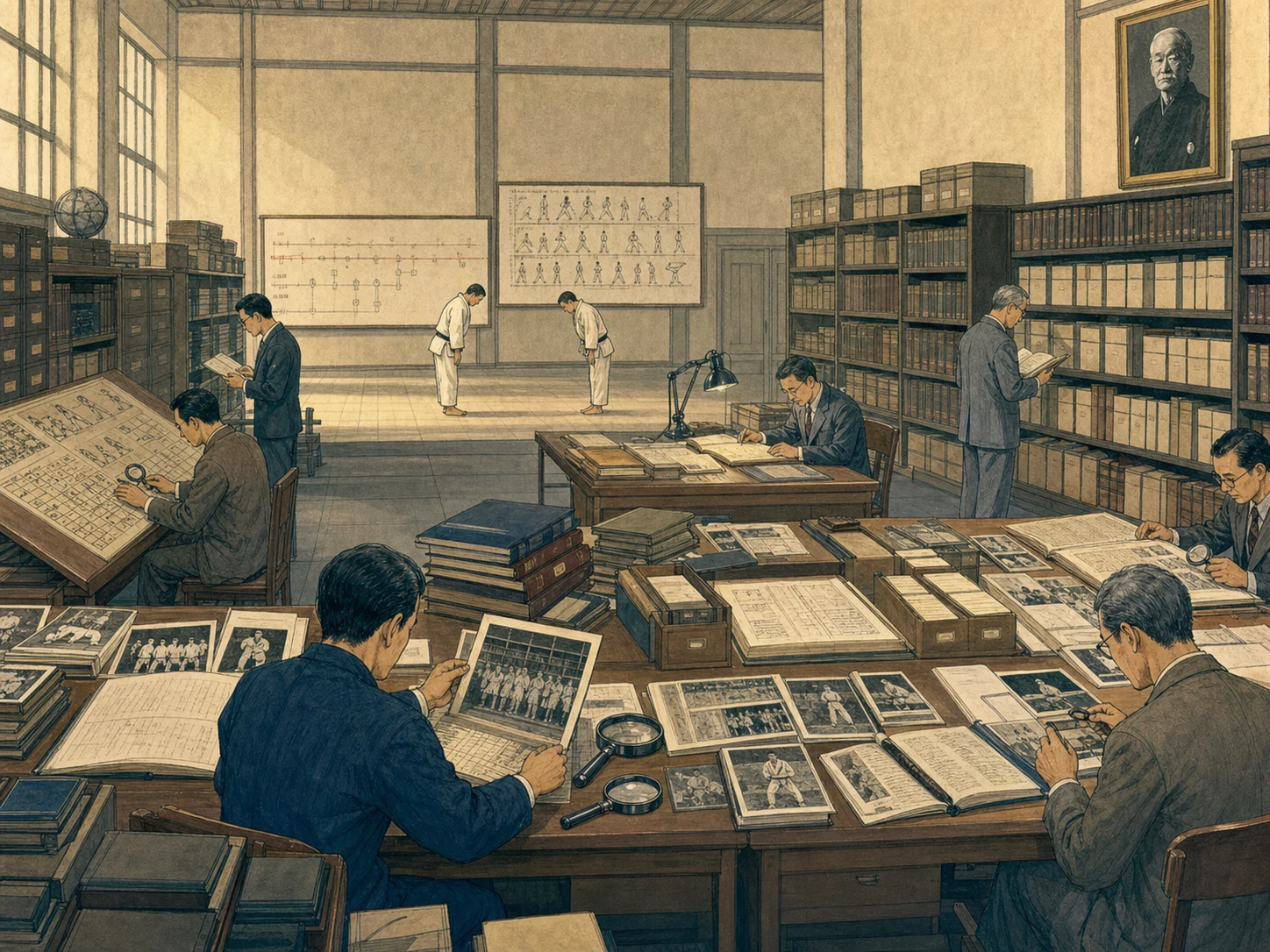
1970s Japanese educational manga-style illustration of researchers examining old photographs, competition records and technique charts in a large judo archive, with two judoka bowing in the distance and a portrait of Jigoro Kano on the wall
Photographs, competition records and technical documents help researchers trace changes in judo practice and institutions.

History, culture and systems

Judo research asks not only how athletes perform, but who is seen and how traditions survive

Kata competition in different national contexts

A comparison of the 2025 national kata championships in the Netherlands and South Africa shows two workable models. The Dutch system is specialised and expert-led; South Africa combines kata with shiai and adaptive judo to reduce venue and long-distance travel costs. The lesson is not that one country is simply right, but that organisation must respond to geography, population and resources.

Women's judo history is about power and opportunity

Using federation archives, the press and biographical sources, the French study traces how women negotiated legitimacy on the tatami through cultural change, federation policy, commercial forces and Olympic sport.

Kosen judo and 27 historical tournaments

The Kosen paper reconstructs competition records from 1914 to 1940, including team succession contests, draws and the tactical importance of groundwork. It is a historical review, not a proposal to apply those rules unchanged today.

Full issue guide

What do the 11 academic papers and one commentary actually cover?

This table translates each contribution into plain language and identifies its evidence type.

TopicPlain-language meaningEvidence type
Judo and violent conflict preventionEthically grounded long-term teaching may support self-control, resilience and cooperation; the effect is not automatic.Interdisciplinary review
Kata in the Netherlands and South AfricaCompares a specialised event model with a resource-efficient integrated model.Observation and document comparison
Junior-high-school awareness of shime-wazaSurveys 340 judoka about loss-of-consciousness experiences, feelings, reporting and return to practice.Questionnaire study
Bilirubin and exercise stressExplores whether non-invasive samples could monitor stress and recovery responses.Nine-athlete pilot
EducaJudo for ages three to fiveExamines whether attention, emotion and behaviour skills learned in judo transfer to home and school.Interviews and parent survey
Preschool judo education modelBuilds an age-appropriate framework from Kano's educational philosophy.Philosophical analysis and theory building
Women in French judo historyStudies how culture, policy, markets and Olympic sport shaped women's place in judo.Historical and archival research
Decision-making circuit trainingProposes 18 constrained scenarios for more systematic technical-tactical practice.Framework awaiting empirical validation
ADHD and judo pedagogyUses dopamine, noradrenaline, immediate feedback, skill progression and physical activity to frame support for attention and behavioural regulation.Conceptual paper; not a clinical trial
Post-Olympic World Championship patternsExamines participation, representation, seeding, age and Mixed Team trends from 2022 to 2025.Descriptive trend analysis
Twenty-seven Kosen judo tournamentsReconstructs the history of team contests, draws and groundwork from 1914 to 1940.Historical review
Safe falling for older adultsExplores how progressive ukemi practice can support safer landing and reduce fall-related injury.Professional commentary and programme framework

Direct answers

What can we reasonably say after reading this issue?

Can judo help prevent violence?

It can, when it is taught with the right values. Studies reviewed in the journal associate long-term judo and martial arts training grounded in etiquette, self-control and respect with lower aggression and higher emotional intelligence. The IJF's Judo for Peace programme applies the same thinking in conflict-affected communities. The benefit comes not simply from learning throws or competing, but from coaches making mutual welfare part of everyday practice.

Can judo treat ADHD?

Judo should not be described as an ADHD treatment. This issue presents a conceptual account of how dopamine and noradrenaline may be engaged through regular exercise, immediate feedback, skill progression, partner interaction and clear lesson pacing. These features may support attention, self-regulation and behavioural control, but the paper provides no clinical proof of treatment. Judo is an educational and developmental support, not a replacement for professional assessment, healthcare or school support.

Should children practise shime-waza?

Shime-waza should not be treated as an ordinary technique for children to try by themselves. Japan has prohibited it in junior-high-school competition since 2022. In this issue's survey of 340 junior-high-school judoka, 25.0% of boys and 17.4% of girls reported having lost consciousness through shime-waza; only 49.1% reported the event to an instructor, and 6.4% reported injury after the event. The findings support strict supervision, immediate stopping, complete reporting and age limits. Local rules and qualified coaching remain essential.

How can judo support fall prevention for older adults?

The most useful approach is to connect balance, strength and safer landing practice. Leg and core strength, multicomponent balance training and a safer living environment can reduce fall risk. Ukemi teaches people how to protect the head and neck, avoid bracing with a straight arm and spread impact when balance is lost. The Safe Falling Programme provides a practical starting point for supervised work on these skills. More long-term research is needed, but it gives judo a clear and constructive role in older-adult fall safety.

What is Kosen judo?

Kosen judo is a tradition developed through team contests for Japan's former higher schools and vocational schools, with a strong emphasis on groundwork. “Ko” comes from koto-gakko and “sen” from senmon-gakko. Kyoto Imperial University organised the first tournament at the Kyoto Butokuden in 1914. The paper reviews 27 tournaments from 1914 to 1940: the proportion of contests decided by katame-waza rose from 31.0% in 1914 to 91.3% in 1930, showing how groundwork became central to this format.

Sources

Source, version and editorial approach

This page is based on the IJF introduction published on 28 June 2026 and the complete 108-page PDF of The Arts and Sciences of Judo, Volume 6, Number 1. It is a Hong Kong Judo guide, not an official IJF translation. Health, psychology and child-development content is educational and does not constitute diagnosis or treatment advice.