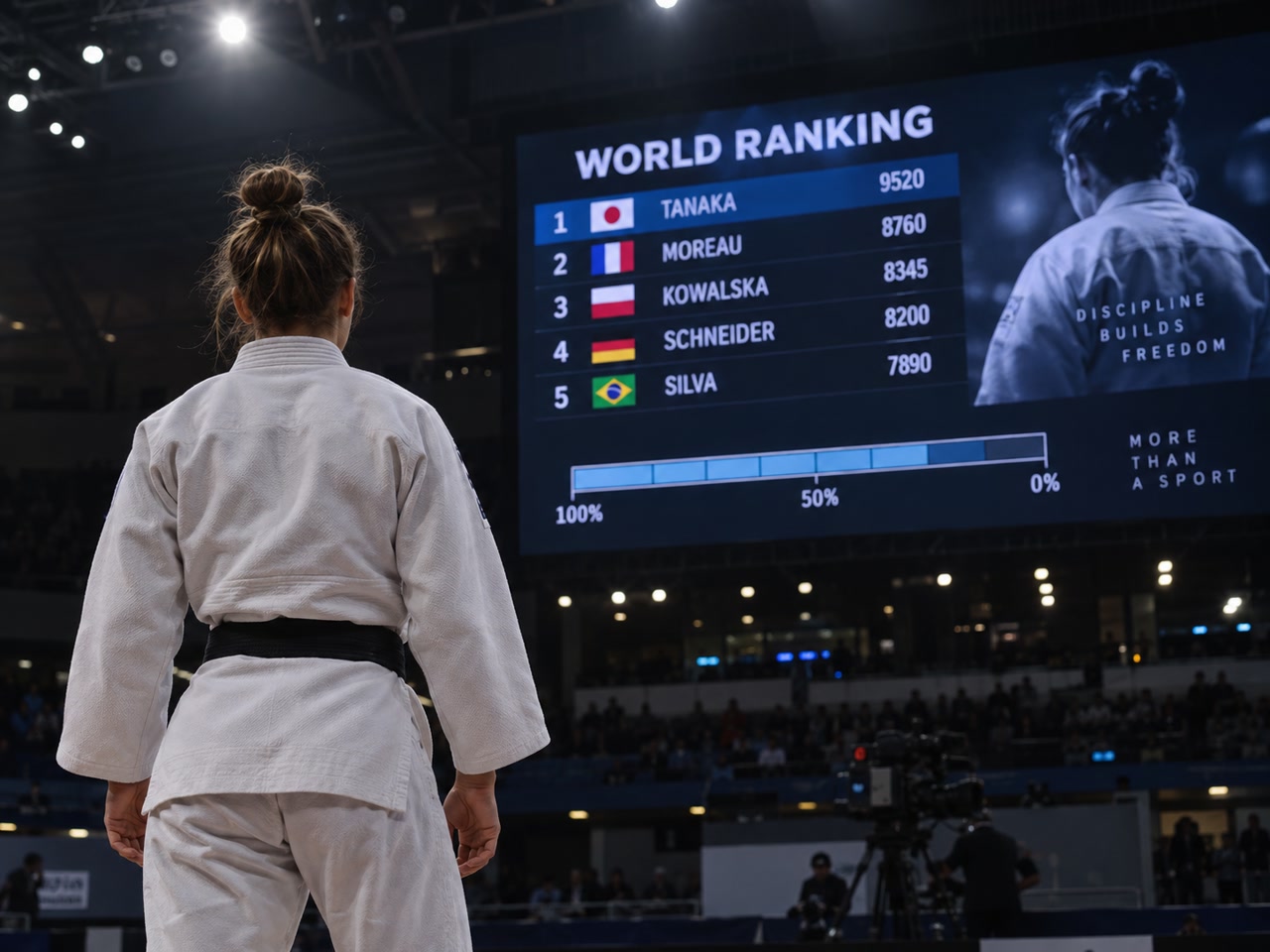
The IJF World Ranking List is the ranking the International Judo Federation calculates for each weight category. It determines seeding, draw position and qualification context for major events. It is points-based rather than a simple count of gold medals.
The most important rule is that results lose value over time. Points earned at an event keep 100% of their value for the first 12 months, drop to 50% after that, and expire at 24 months.
Take a 1,000-point result. For the first 12 months it contributes the full 1,000 points. After 12 months the same result is worth 500. After 24 months it contributes nothing at all.
The change is tied to event timing and ranking-week logic rather than a blanket reset on 1 January. Different athletes therefore lose points at different moments through the year.
Rankings can also move when an athlete does not compete. As rivals' older results lose value or expire, a position can rise or fall without anyone fighting.
When points are level, the International Judo Federation applies its published tie-break rules. The current federation explainer is the authority on the detail.
Ranking matters in three practical ways. First, seeding, which shapes where an athlete sits in the draw. Second, draw position, which determines the route through a competition. Third, qualification context for major events, including Olympic qualification.
One caution: the World Ranking List and the Olympic Ranking are related but they are not the same system. The Olympic ranking has its own window and its own qualification rules, and the two should not be described as identical.
Ahead of the 2026 Baku World Judo Championships, the International Judo Federation published its women's ranking analysis on 21 September, covering all seven categories. The leading figures are below.
At under-48 kg, China's Wenna Zhuang is one of the major Baku focuses. At under-52 kg, Ayumi Leiva Sanchez is a major contender. At under-57 kg, Eteri Liparteliani is a major contender.
At under-63 kg, Haruka Kaju is a leading ranking figure. At under-70 kg, Lara Cvjetko leads in the federation's current analysis, with Shiho Tanaka a major contender.
At under-78 kg, Anna Monta Olek is a major contender. At over-78 kg, Raz Hershko is a major contender. Each of these athletes features in the federation's analysis, but not every one of them is the current world number one in their category.
Sources
- International Judo Federation — Understanding the 2026 IJF World Ranking season
- International Judo Federation — The women's world ranking is ready for the World Championships (21 September 2026)
- International Judo Federation — World Ranking List
- International Judo Federation — Baku World Judo Championships 2026 event page