
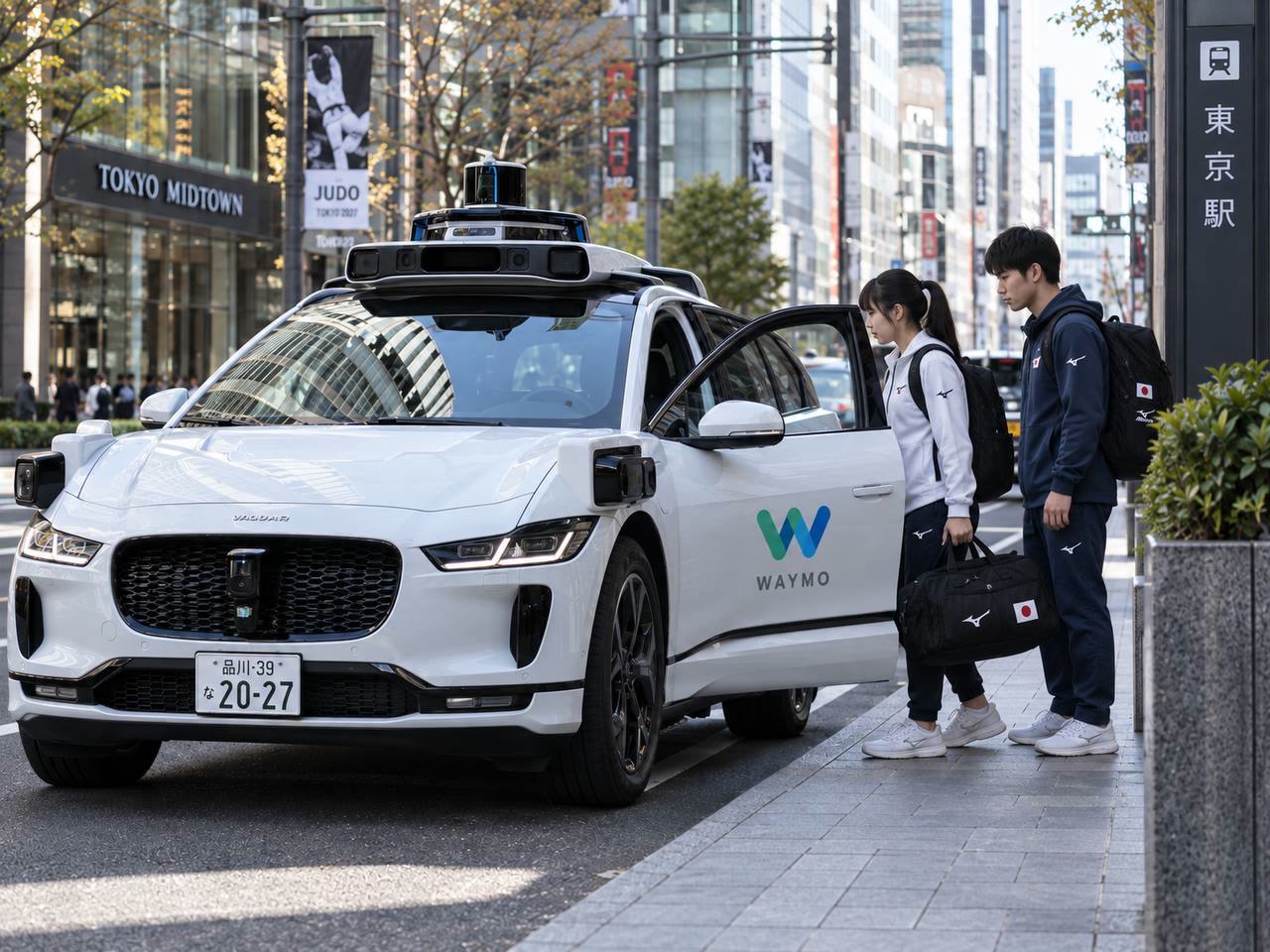
For anyone travelling to Japan for judo exchange, training at the Kodokan, or taking a team to a competition, transport is often the most practical part of the trip. After a late-evening session, once the last train has gone, or when several people are moving between hotel and venue with judogi, luggage and competition kit, a taxi you can call directly is often far easier than changing trains two or three times.
From 2027, that journey in Tokyo could look very different.
In September 2026 Waymo, GO and Nihon Kotsu set out the next stage of their partnership, targeting Japan's first Level 4 fully driverless commercial taxi service in Tokyo in 2027. Under the plan announced so far, the service will begin with a smaller fleet and scale gradually to around 100 vehicles, with rides booked through GO — Japan's most widely used taxi app — and the Waymo app.
That timetable still depends on approval from Japan's national and local authorities, and on validation of the Waymo system and live operations. 2027 is a target, not a guaranteed launch date. Even so, the three companies have moved from straightforward road testing to preparing for commercial passenger service.
Waymo has been testing on Tokyo roads since 2025, with trained Nihon Kotsu crew taking part in live road operation so the system can adapt to Tokyo's narrow streets, busy junctions, dense pedestrian traffic and distinctive road environment. Waymo says the future Tokyo service is intended as round-the-clock on-demand transport that complements the existing rail and taxi networks.
For people who travel to Japan regularly for judo, this is a very practical development. If the plan lands, the next Tokyo training camp could mean leaving the dojo after an evening session, opening GO, entering a hotel address, and having a Waymo with nobody inside come to collect you. For visitors who do not speak Japanese, destination, route and payment are all handled in the app, removing the need to explain an address to a driver.
For a judo group carrying large kit bags, luggage and perhaps several children, point-to-point transport is part of the journey itself. If a robotaxi can genuinely be called 24 hours a day, that has direct value for late-night training, early flights, airport transfers and cross-district travel.
Hong Kong should take note.
Hong Kong has not stood still. The Road Traffic (Autonomous Vehicles) Regulations have been in force since March 2024, and the Transport Department has established a pilot licence system for autonomous vehicles. During 2026 Hong Kong has approved further road trials, including driverless testing on Airport Island and an autonomous trial between West Kowloon Station and Kowloon Station. The Government has also said it is studying regulatory arrangements to allow autonomous vehicles to provide a degree of commercial service in designated areas.
What Hong Kong needs to discuss is therefore no longer simply whether testing is possible, but how to move from trials to services that residents and visitors can actually use.
If Tokyo can let ordinary passengers book a fully driverless commercial taxi through an app in 2027, Hong Kong should move faster to establish a clear framework and timetable for limited commercial passenger service, so that qualified driverless taxis can begin carrying passengers once safety and regulation are mature.
The first phase need not cover the whole territory. Hong Kong International Airport, AsiaWorld-Expo, the West Kowloon Cultural District, Kai Tak, the cruise terminal, and major hotels and transport interchanges are all worth studying. These are places with concentrated visitor numbers and clear transport demand, and they are where overseas visitors would feel the benefit most directly.
For a tourism city, a driverless taxi is not only a piece of transport technology. A visitor lands, calls a car on their phone, and reaches a hotel, venue or tourist district without cash, without explaining a destination, and without speaking Cantonese. That experience is itself part of a city's tourism service and its technology image.
Tokyo is preparing to turn this from testing into a real commercial service.
Hong Kong already has regulation, trials and driverless road experience. The next step should be to use that foundation to move faster, and — with safety assured — to approve limited commercial driverless passenger service as early as possible, so the technology becomes transport that residents and visitors can genuinely use.
For us, the simplest expectation may be this.
The next judo exchange in Japan: walk out of the dojo after training, open GO, and a taxi with no driver may genuinely come to collect us.
And when judoka from overseas next visit Hong Kong, we hope the city can offer the same convenience.
Sources
- Waymo: Opening our doors to Tokyo riders in 2027 (September 2026)
- GO: Agreement on the commercialisation of autonomous taxis (15 September 2026)
- Waymo Japan
- Hong Kong Transport Department: Trials of Autonomous Vehicles
- Hong Kong Government News: Autonomous vehicles trial approved (11 August 2026)
- Transport and Logistics Bureau: Promoting autonomous vehicles (29 April 2026)