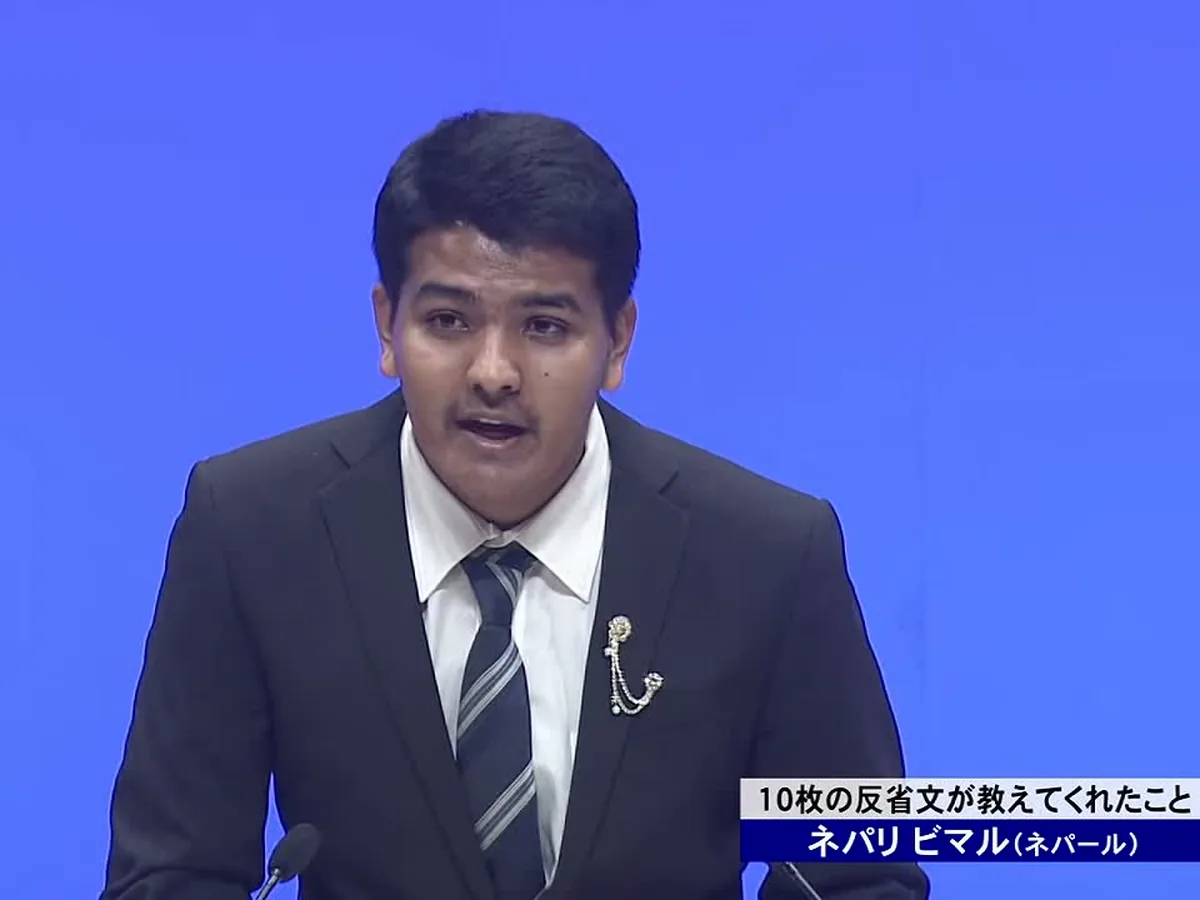
A Japanese-language speech by Bimal Nepali, a speaker from Nepal, has recently circulated on social media. On 3 October 2026, he received Japan's Minister for Foreign Affairs Award at the 65th International Speech Contest in Japanese, held in Ibara, Okayama Prefecture, for his speech, "What Ten Pages of Reflection Taught Me."1,2
He described how he once responded angrily on social media after encountering hostility towards foreigners. In that response, he argued that foreigners were helping Japan. But he came to realise that answering hostility with hostility only deepened the divide. His reflection led him to call for respect for differences and a more inclusive Japan.3
Rather than simply condemning Japan, his speech was about overcoming division. The tension it exposed also deserves attention from the Japanese judo community.
Registered judo membership falls by nearly 40% in 21 years
According to the All Japan Judo Federation, individual registrations declined from 202,025 in fiscal 2004 to 125,336 in fiscal 2025, a loss of 76,689, or approximately 38.0%. Primary school registrations fell from 47,512 to 30,057 (−36.7%); junior high school registrations from 48,485 to 25,945 (−46.5%); and senior high school registrations from 38,432 to 16,703 (−56.5%).4
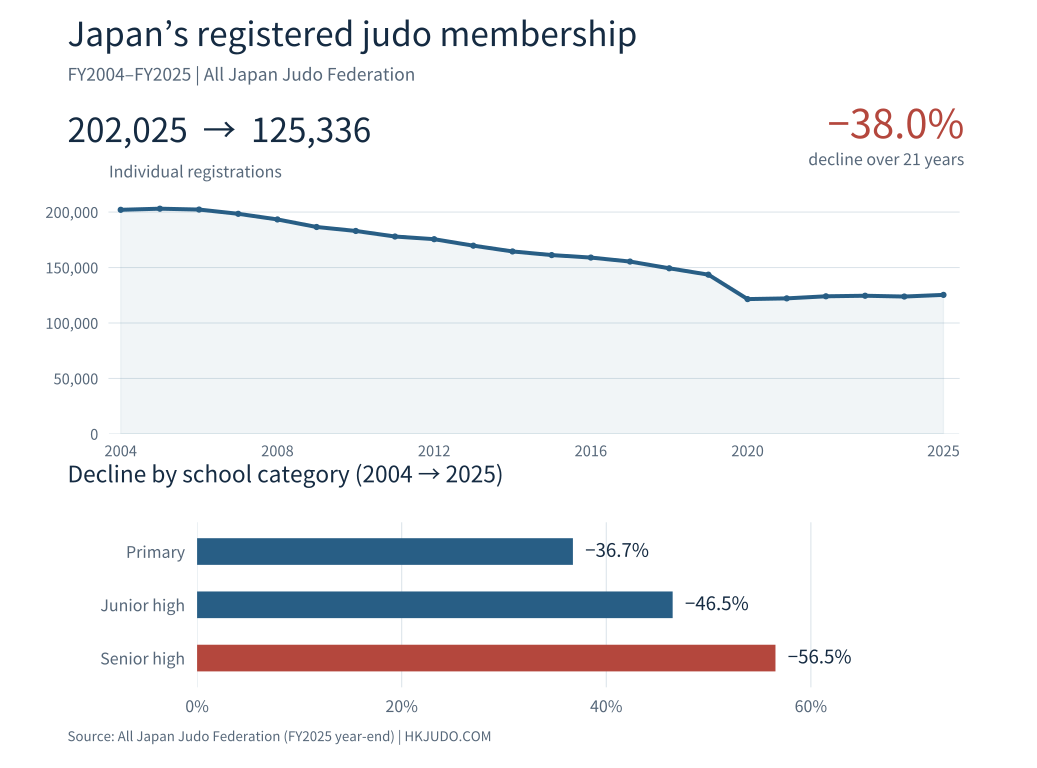
Chart: HKJudo; data: All Japan Judo Federation.
Overall registrations rose slightly in fiscal 2025 compared with the previous year, and primary school registrations also increased. Nevertheless, the long-term decline remains a concern. Against the backdrop of falling birth rates, school judo clubs and community dojos face the challenge of sustaining participation and developing future instructors. These figures represent federation registrations, not a census of everyone practising judo in Japan.
Needing foreign participation while risking exclusion
Japan's Ministry of Health, Labour and Welfare reports that approximately 670,000 births to Japanese nationals were recorded domestically in 2025. At the end of October that year, the number of foreign workers in Japan reached a record of approximately 2.57 million.5,6
As Japan increasingly relies on the contributions of foreign residents, exclusionary rhetoric can leave those who wish to integrate feeling unwelcome. This tension also matters to the judo community.
Many practitioners around the world admire Japan, respect its culture, study Japanese and devote considerable time and money to practising judo in its birthplace. They are not merely students of Japanese judo culture; they can also help preserve and share it.
If the judo community worries about declining participation yet turns away willing practitioners simply because of nationality, language or cultural differences, it risks undermining its own future. This is not true of every Japanese dojo: the Kodokan and numerous organisations actively promote international exchange. Nor do the available statistics establish exclusion as a cause of declining registrations. The question is whether international engagement can be translated into sustained, equitable opportunities to participate.
Is mutual welfare and benefit becoming just a slogan?
Jigoro Kano founded judo not simply to produce strong athletes but as a means of education and human progress. The principles of Seiryoku Zenyo and Jita Kyoei should transcend nationality, ethnicity and language.
Judo was born in Japan, but today it is practised around the world. Perhaps the future requires not only Japan teaching judo to the world, but also judoka from across the world helping Japan preserve this valuable cultural heritage.
If the world still loves Japanese judo, is Japan willing to welcome judoka from around the world with open arms?