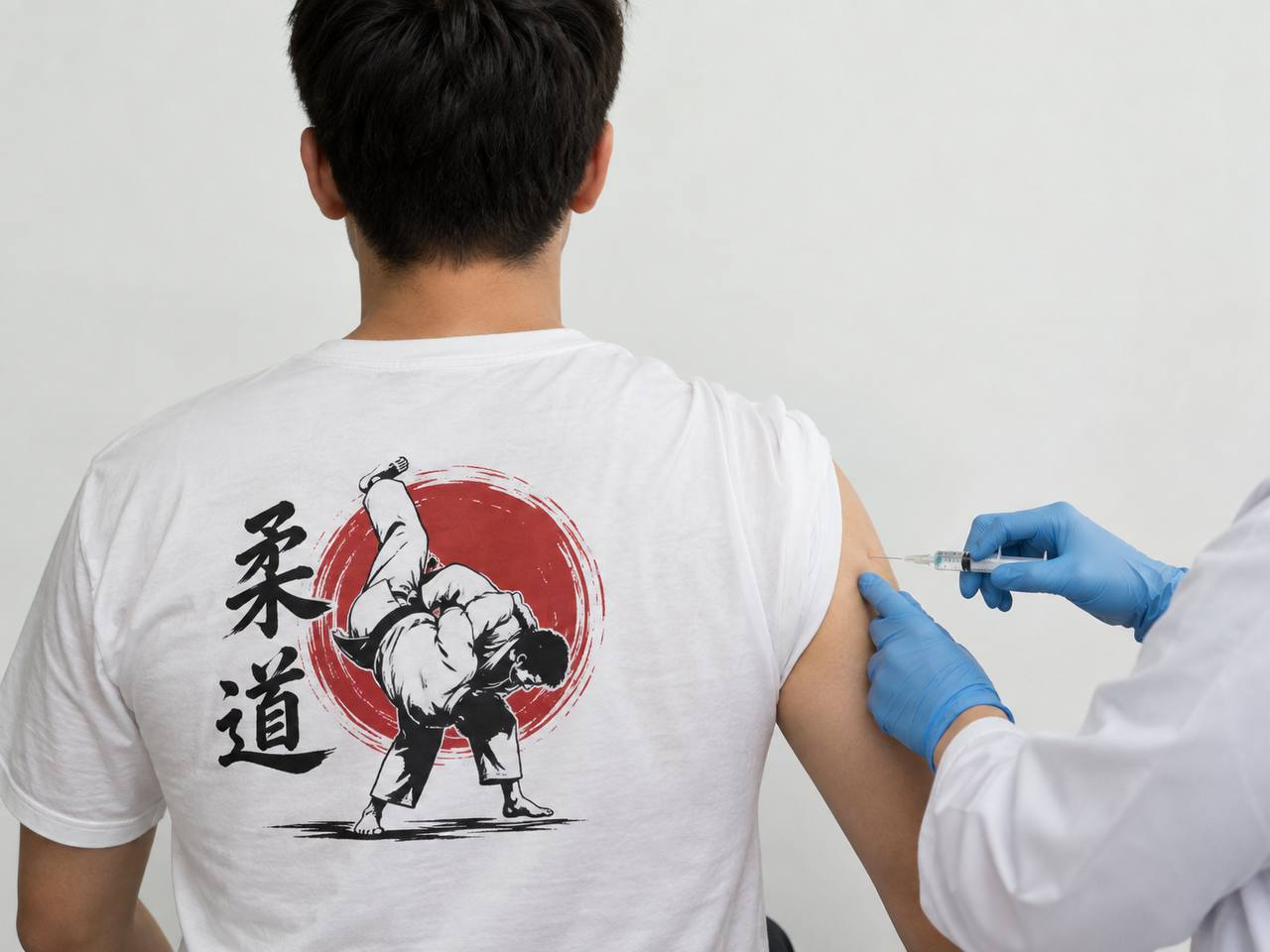
Hong Kong has once again entered flu season. For judo and all athletes, seasonal influenza vaccination is especially important.
According to the latest surveillance by the Centre for Health Protection, overall influenza activity in Hong Kong remains at a high level. In Week 38 of 2026, from 13 to 19 September, 854 of 9,403 respiratory specimens tested positive for influenza A, giving a positivity rate of 9.08%, with H1 being the dominant subtype. The 2026/27 Seasonal Influenza Vaccination Programme also began on 17 September. (Hong Kong Centre for Health Protection)
For judo and other sports, this deserves particular attention.
When an athlete catches influenza, the impact does not stop with that individual.
They may pass the virus to training partners, coaches and children, who can then bring it back to schools and families.
The Hong Kong Centre for Health Protection recommends annual seasonal influenza vaccination for everyone aged six months or above, except those with known contraindications. Vaccination does not prevent infection 100%, but it can reduce influenza and its complications, as well as the risks of related hospitalisation and death. It also takes about two weeks after vaccination for an adequate immune response to develop. (Hong Kong Centre for Health Protection)
“But don’t COVID vaccines cause people to die suddenly?”
Whenever vaccines are discussed, another claim almost always appears online:
“Since COVID vaccination, many more people have suddenly died.”
The biggest problem with that statement is that it is actually a hypothesis that can be tested with data.
It should not be judged by Facebook screenshots, YouTube videos or stories from “a friend of a friend”.
In March 2026, PLOS Medicine published a large population-based study involving 6,365,451 people aged 12 to 50 in Ontario, Canada, specifically examining the relationship between COVID vaccination and sudden death among young people who appeared healthy.
The study identified 4,963 sudden deaths that met its study definition.
So what did it find?
It did not find that COVID vaccination increased the risk of sudden death.
The researchers specifically examined the six weeks after vaccination and again found no increase in risk. They also used a self-controlled case series method, comparing the risk period after vaccination with other periods in the same individual. Sudden death rates did not rise significantly after the first, second or third dose.
The authors’ conclusion was very clear:
The data did not support the hypothesis that COVID-19 vaccination increases the risk of sudden cardiac death in young healthy adults. (PubMed)
Notably, in the general case-control analysis, vaccinated people actually had a lower statistical odds of sudden death, with an adjusted odds ratio of 0.57.
In other words, in this case-control analysis, the odds of sudden death among vaccinated people were about 43% lower. However, this was an observational study and cannot be directly interpreted as meaning that “vaccination reduced sudden death by 43%”. The important point is that the study did not show the increase in sudden-death risk claimed by anti-vaccine narratives.
The United States also examined death certificates directly
The US state of Oregon also investigated this question.
Researchers reviewed all 1,292 deaths among residents aged 16 to 30 from June 2021 to December 2022 and matched them against vaccination records.
Between May 2021 and December 2022, about 979,289 doses of COVID vaccine were administered in this age group.
The study did not identify any cardiac death that could be definitively attributed to an mRNA vaccine and that occurred within 100 days after vaccination.
By contrast, 30 people in the same age group died from COVID-19 during the period.
The conclusion was the same: the data did not support an association between mRNA COVID vaccination and sudden cardiac death in previously healthy young people. (US Centers for Disease Control and Prevention, CDC)
Another study using data from eight healthcare systems in the US Vaccine Safety Datalink also found no increased risk of all-cause death, non-COVID death or several categories of cardiac death within 14 or 28 days after Pfizer or Moderna vaccination. (PubMed)
“Died after vaccination” does not mean “died because of vaccination”
This is also one of the most common logical errors in anti-vaccine arguments.
Billions of people worldwide have received COVID vaccines. In the week, month or year after vaccination, some of them will of course still develop cancer, have a heart attack, suffer a stroke, be involved in a traffic accident or die suddenly.
If data from 6.36 million people are ignored in favour of a single news report; if no one asks about the death rate and only counts “people who died after vaccination”; if background rates and control groups are not even considered before declaring causation, that is no longer scientific scepticism.
Do not let fear and distrust of science affect other people. Vaccination is one important way to protect yourself and others.
Sources
- Centre for Health Protection — Influenza surveillance data, week 38
- Centre for Health Protection — Government Vaccination Programme 2026/27 (commenced 17 September 2026)
- Centre for Health Protection — Frequently asked questions on seasonal influenza vaccination for the 2026-27 season
- PLOS Medicine — Association between COVID-19 vaccination and sudden death in apparently healthy younger individuals (19 March 2026)
- Centers for Disease Control and Prevention — Assessment of risk for sudden cardiac death among adolescents and young adults after receipt of COVID-19 vaccine, Oregon (MMWR, 11 April 2024)
- Vaccine — Mortality risk after COVID-19 vaccination: a self-controlled case series study (2024)